Showing posts with label Mutton. Show all posts

Tuesday, July 07, 2020

Recipe : Haleem - Mutton and Wheat Porridge

Haleem is a traditional dish of meat (mutton) and wheat that is stewed overnight during Ramadan, so it can be had as a nutritious and filling breakfast before sunrise the following day. Hyderabad has the most amazing varities of Haleem available during this period and we endeavoured to taste our way through as many of them as possible. It's a dish that is definitely worth waking up early for , but these days its available all around the year.

Haleem at home is served with toppings on the side, so everyone can choose their favourite flavours.


Since I wanted to recreate the recipe at home with better quality boneless mutton, I followed the recipe from the Essential Andhra Cookbook by Bilkees Latif, with my minor adjustments


Ingredients :
1/2 kg boneless mutton (or chicken)
1 tbsp garlic paste
1 tbsp ginger paste
Juice of half a lime
1/2 kg broken wheat (dalia)
1 handful each masoor (Egyptian / red), channa (Bengal gram) and moong (husked green gram) dhals/lentils
2 tbsp ghee (Bilkees recommends 1/2 cup)
2 onions finely sliced
6 cloves
6 cardamom
2 " cinnamon
1 tbsp corriander powder
red chilli powder to taste
1 tsp ground caraway seeds - I skipped this
3-6 green chillies sliced or ground
1/2 tsp haldi - for colour I added
water
salt to taste

Options For Garnish :
chopped mint
quartered limes
chopped corriander leaves
chopped green chillies
ginger juliennes


Method :
Marinate mutton overnight in ginger garlic paste and lime juice.

Wash the dhals.
Soak dhals and broken wheat for 1 hour (or overnight if you want to cook this as soon as you wake up as a breakfast dish)

Heat ghee

Fry sliced onions till crispy brown and then remove from the pan.

In the same ghee, fry cloves, cardamoms, cinnamon for a minute.

Add the spice powders and stir a bit.

Before the powders begin to burn, add the meat and marinade and saute till brown.

Add green chillies, soaked wheat, soaked dhal, 4 cups water and close the pressure cooker.

Cook under pressure for 30-45 minutes.

Open and dry out to desired consistency (like porridge)

Mash the meat and wheat a bit.

Add salt to taste.

Garnish with your choice and combination of fried onions, chopped chillies, chopped mint, ginger  or chopped corriander

Friday, December 06, 2013

Recipe : Kheema / Mince Parathas

This is a great way to finish up leftover mince - whether it is  chicken, mutton or beef mince. And it turns into a complete meal, with just some raita on the side, especially if you have peas or carrots in your mince.

Ingredients : 
1 portion leftover mince
wheat flour
salt to taste
water for the dough
a little oil or ghee for frying

Method:
Mash the mince a bit if you have large vegetable chunks in it and dry it out, if it is liquidy.
Bring the mince back to room temperature.
Make a dough with wheat flour, salt to taste and water.
Make lemon sized balls and flatten them into circles, thick in the center and thinner at the edges.
Put a spoon of kheema in the centre and fold the edges over the kheema to form a ball.

Flatten and roll the disc in plain wheat flour.
If using a roti maker, put a dab of oil on each side (without rolling in flour) and make rotis as normal.
If using a tawa, fry on each side on a low flame, putting just a little oil or ghee on each side to help crisp it up.
Serve hot with cold raita.

Tuesday, August 28, 2012

Recipe: Chicken Ularthiyathu - Kerala style Chilli Chicken with Coconut

This dish is normally made with beef  and served at the roadside toddy shops (kallu shaap) in Kerala. Most starters served in Kerala's toddy shops are tongue numbingly spicy. I suspect the logic is that the hotter the tongue burns, the more toddy you will consume.

I was looking for something different as a starter using chicken & decided to adapt the Malyali Erachi Ularthiyathu recipe for chicken. There are of course plenty of variations of this dish, but that is the beauty of recipes in India.

Ingredients:
1/2kg boneless chicken - cut into strips or cubes - wash, dry and set aside
8-10 black peppercorns
1/2 tsp saunf - fennel seeds
2-3 cloves (lavang)
1" cinnamom
1 cardamom pod
2" ginger
8-10 cloves garlic
3 sprigs curry leaves
2 tbsp red chilli flakes (chilli flakes will be preferable to chilli powder in this recipe)
1tbsp vinegar (I use a coconut toddy vinegar for more flavour)
1 large onion finely sliced.
3-4 green chillies
1/4 cup grated coconut or thin coconut slices (I'm more comfortable grating coconut than slicing it finely, but finely sliced coconut will give you a better flavour and texture)
coconut oil
salt to taste

Method:
Heat a frying pan to just below smoking point. Then on a low flame, dry roast the peppercorns, saunf, cloves, cardamom, cinnamon (one ingredient at a time if you aren't sure of cooking times) until they start to release their fragrance.

Put them into a mortar & pestle or the dry grinder attachment of a mixi, or a coffee grinder.
When the spices have cooled,. grind them into a coarse powder.
You can also grind the ginger and garlic into the same spice mix or use ready made pastes.

Marinate the cleaned & dried meat in this spice mixture and also add the chilli flakes, vinegar and 1 sprig of curry leaves.
Marinate anywhere between an hour to 24 hours. Overnight is ideal.

In a large pan, heat 1 tbsp coconut oil and fry the shaved/grated coconut in it. Drain & remove from the pan when light brown.
Add another 2-3 tbsp of coconut oil to the pan.
Fry the onions and green chillies until it turns soft and begins to brown.
Then add the remaining curry leaves, saute for a minute and add the marinated chicken.
Gently saute on a medium flame until the chicken is cooked.
Then add the fried coconut and mix well.

Serve as a snack, or a side with hot rice and dhal or any polis or rotis.


Options:
This dish can also be made with beef or mutton, but then you need to add an extra step.
Pressure cook the marinated beef/mutton without any liquid when cooked, dry out any liquid that remains by frying slowly.
Add the cooked beef/mutton at the same stage as the chicken in the above recipe. Fry well with the onion mixture for a minute or so until well coated and then add the fried coconut.

Monday, August 27, 2012

Recipe: Mangshor Jhol - Bengali Mutton Curry

Jhol is a thin Bengali curry. Mangshor is mutton (goat meat, lamb can be used as a substitute if goat isn't available).

In my singleton days in 1999-2000, I had a group of 8-10 Bengali & Oriya friends who rented the first floor of a house in Bangalore. My apartment had a very basic kitchen, but these guys had a slightly larger kitchen. If I was in Bangalore for the weekend, then most Sunday afternoons were spent with this group of friends, because they would make awesome mutton curry with hot rice that was so welcoming after a week of slogging away at office and eating fast cooked meals. (normally pulaos of every kind where meat and veggies were tossed into a pressure cooker with herbs and spices & cooked for 3 whistles) Plus after Saturday night out on the town, this mutton curry really hit the right spot at 3pm after waking up at 2pm.

I normally don't cook a lot with mutton. The quality of mutton that you get in Mangalore is not very good. It is stringy, fatty and sometimes a bit smelly, so mum n grandma also rarely cooked mutton unless it was a traditional polov (Mutton & ash gourd curry) needed for some ceremony or the occasional stew, butI remember grandma used to add beef to that dish just to get some better quality meat into it.

Personally, I mostly cook mutton only in Biriyanis or the occasional chops. I did cook more with mutton wheil I was in Bombay & I do believe that the best quality mutton in India is found only in Maharashtra and Rajasthan. So I was quite suprised to recently learn that a lot of Rajasthan's mutton is imported from Gujarat under the so-called "Pink Revolution" akin the "White Revolution" where Gujarat exports milk & milk products to other Indian states

As I was hosting a dinner party for 20, I thought I should do something other than the regular biryani with mutton (as cooking biryani for 20 needs much bigger pots than I have) or a stew (since I was already making the chicken curry with coconut milk) and I remembered the simple homestyle mutton curry that my Bengali friends used to make on the weekends. I looked up a couple of my recipe books and some online recipes, then decided on the following. I cooked with 2 kilos of mutton. 1kg boneless + 1 kg with bone so you can halve the quantities for 1 kg.


Ingredients:
2kg mutton (use at least some large bones) - chop into curry size pieces, wash and drain

Marinade:
2 tsp turmeric powder
2 tbsp red chilli powder (adjust to your spice tolerance)
6 tbsp mustard oil
8 tbsp thick curd (yoghurt) - drain it in a cheesecloth if your curd is too watery
6-8" fresh ginger
25-30 cloves of peeled garlic
8 green chillies (adjust to your spice tolerance)
salt to taste

In a mortar & pestle coarsely crush the ginger, garlic and green chillies (you can use a chopper or mixi if you prefer, but the mortar&pestle give the best flavour) You can also use ginger paste & garlic paste and just smash the chillies with back of your knife.
Mix all the marinade ingredients together, adjusting salt for taste and marinate the meat in it for a couple of hours. Overnight in the fridge works best and even longer will work as well.


Ingredients:
2kgs marinated mutton (as above)
6 medium onions sliced finely
1/4 cup mustard oil (since this adds flavour, don't decrease oil at this stage, you can strain it off the top, once the dish is ready)
4-5 bay leaves
3-4 dried red chillies
6 medium potatoes peeled and chopped into 8 each (if you like larger sized potatoes, just quarter them)
2 tbsp turmeric

3 tbsp corriander powder
2 tbsp red chilli powder
2 tbsp jeera powder
salt to taste
fresh lime segments
corriander leaves to garnish - optional

Method:
Bring the marinated meat to room temperature if refrigerated.
Add a little salt & 1 tbsp turmeric to the chopped potatoes and mix well.
In a large pan/ pressure cooker, fry the potatoes in 2-3 tbsp mustard oil, until they start to brown/crisp up on the outside.Stir frequently to prevent potatoes sticking to the pan.
Remove the potatoes from the pan, leaving the excess oil behind.

Add the rest of the oil to the pan.
When hot, season with the bay leaves and dried red chillies.
Before the chillies can burn, add the sliced onion and fry well until they start to brown.
Stir frequently to fry evenly and prevent them from sticking to the bottom

Add the marinated meat (but reserve the excess liquid marinade) to the pan with the remaining turmeric, chilli, corriander & jeera powders and some salt
Stir frequently to prevent meat sticking to the pan and cook till all the liquid dries up and the meat is well coated with the marinade and powders and slightly browned..

Add the reserved marinade, fried potatoes and 6-8 cups of water (depending on how thin you want the stew).
Cover and cook till done (3 whistles in a Hawkins pressure cooker)
Adjust salt to taste.
Cook uncovered if you want to thicken the gravy

Just before serving, squeeze lemon juice or serve lemon wedges on the side.
Add corriander leaves if you like as garnish

Serve hot with rice or lucchis (maida puris)


This jhol/curry can also be made with lamb or chicken

Kim's tips:
1. Choose a good quality mustard oil, as that will make a huge difference in the taste. There is no substitute for mustard oil in this particular recipe.
2. Mutton curries need some amount of large bones in the mix which really flavour the stew
3. If you are refrigerating meat during marination, always remember to bring it back to room temperature before cooking it.
4. Onions fry a little faster if you add a little salt to them while frying.

Sunday, October 16, 2011

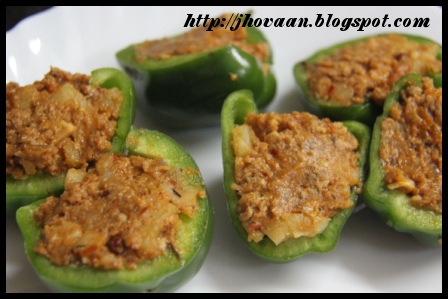
Recipe: Stuffed Capsicum (with leftover mince)

This is another lovely way to use up leftover mince rather than just making cutlets out of it. You need small capsicums for this dish and not the regular size. Chopping the capsicum into smaller pieces won't help, because we want the curve to hold the filling in.

Most mince dishes will go well with this recipe. I normally do this with an Indian recipe for mince, but I use others too. Leftover shepherds pie when all mixed together does the trick too. If you have mince from your burgers, that will work too but remember to cook the mince before stuffing it.

This time I had some leftover bolognese sauce made with chicken mince. I just dried off the sauce on a stove top and added some boiled potatoes to the mix so it would bind together.

Ingredients:
Leftover cooked mince (chicken/mutton/beef/burger)
Some boiled potato to bind it together if necessary
Baby capsicums (depending on how much leftover mince you have)
1-2 eggs beaten with some salt and pepper

Method:
Deseed the capsicum and split in half. You can leave it whole if you want to bake it in the oven.

Warm the mince to slightly above room temperature and stuff the capsicum halves with it.

Dip the capsicums in the egg batter and put them in a heated & lightly greased frying pan, mince side down first. The egg will slide down the rest of the capsicum, don't worry about it.

Fry it on a really low flame, so the egg won't burn but the edges of the capsicum touching the pan on this side can cook.
Then gently turn it over and fry on a low flame until the capsicum skin is slightly charred. and the capsicum turns to a cooked shade of green.

The dish may not be very pretty to look at, but I assure you its extremely tasty and you won't be able to stop popping them in your mouth.

They go well as a side dish or even smooshed up as a filler for sandwiches.

Wednesday, May 11, 2011

Recipe : Mutton Chops - Kerala Style - from Flavours of the Spice Coast

I roughly followed Mrs K M Mathew's Recipe from Flavours of the Spice Coast. I had earlier tried Chicken Piralen from the same book. While her book is wonderful and has some lovely looking dishes, I wouldn't recommend it to a newbie cook or someone completely unfamiliar with Malyali (Kerala) cuisine. The instructions aren't precise, so unless you know where you are headed and have a fair idea of what you want you dish to taste like, you may find the book quite confusing.


When I made the dish, I mainly used her ingredients with a few changes and roughly followed her recipe with some modifications. It was quite easy to throw together as I just had to chop up some onions, everything else I used powders and pastes.

Ingredients:
1 kg mutton
salt to taste
1 cup water
1 tsp oil - (regular not coconut)
3-4 onions chopped (1.5 cups)
2 tsp ginger garlic paste
1/2 tsp turmeric powder
1.5 tsp chilli powder
1 tsp pepper powder
juice of 1 lemon (or more to taste)
1 tsp jeera (cumin) seeds
4 cloves
4" cinnamon
2 pods of cardamom


Method:
Wash & clean mutton and cook on low flame with the water and some salt.
Drain and reserve stock.


Heat oil, add onion and fry till brown
Add ginger garlic paste and fry some more.

In a bowl, mix all the powders with a little water and add to the onions
Fry well, then add the meat and brown.
Add 1 cup stock(add water if not enough stock) and lime juice, lower heat and simmer for about 10 minutes.

Powder the whole spices roughly and add to the mutton.

When gravy thickens, take off the fire. Garnish with corriander leaves and serve hot with rice or Roti


Read a review of Flavours of the Spice Coast in The Hindu

Tuesday, March 01, 2011

Recipe: Manglorean minced meat with potatoes and peas

Minced meat cooks much faster than regular meat chunks and mum always cooked mince for us when she was in a hurry. Mince is comfort food for me in a strange way. The younger of my 2 brothers LOVES mince and will eat it in any form at any time of the day or night.


When growing up, minced meat usually meant beef. These were the days when Hindu political parties in India were more concerned with social development and had not yet started dictating what food products could and could not be eaten in the country. Beef was much cheaper than mutton and the cheapest option during the monsoons when fishing was just not done (ecological and climate cycles and all).

Now in most states in India, the sale of beef has been banned and buffalo meat is just too tough to bother cooking with,  so its just easier to cook with mutton. So this recipe was originally designed for beef mince, but can be cooked with mutton mince. Beef has a stronger flavour and you may want to use a bit more spices and tomatoes when cooking.

(in this picture it has been served with puris)

Ingredients:
1/2 kilo minced meat - washed and drained

2 medium onions finely chopped
2 tomatoes finely chopped
1" ginger + 4-5 cloves garlic finely chopped or 1 tbsp ginger garlic paste
2 large potatoes chopped in cubes
1- 1.5 cup green peas
1 tsp or more Stew Powder/pepper powder
salt to taste
1/2 tsp oil for tempering
chopped corriander leaves to garnish

Method:
In a pan, heat the oil and add the onions, ginger and garlic (or paste).
Saute till onions turn translucent and then add the tomatoes and cook till it all turns mushy.
Add the potatoes and let them brown slightly, then add the mince, salt and stew powder.
Cook till almost done.
Then add the peas and gently let them steam till cooked.
Garnish with chopped corriander leaves (you can also garnish with a chopped boiled egg to make it look fancier when you have guests over)
Serve hot with puris or rice and dhal

Leftovers:

Its so easy to use leftover mince. There are so many things you can do with it.
Stuff it into samosas
Bake mince puffs
As a topping for home made pizzas
Sloppy joes
Sandwich fillings.
You can smash the potatoes fine and add a little more boiled potatoes if needed and turn them into cutlets.

Note: My friend May who is also Manglorean has a similar recipe for Minced Meat with Vegetables Its almost identical to my mums recipe. So you can compare the two and see how Manglorean cooks have subtle differences while cooking theoretically the same dish.

Friday, January 28, 2011

Recipe: Kashmiri Ghushtaba - Meat Ball Curry - Short cut method

Ghushtaba and Rista are 2 extremely famous Kashmiri dishes. The process of making these dishes that take the most time is the pounding of the mutton to mince it up and turn it into soft meat balls.

I had ordered a home delivery of chicken meat balls along with my regular order from the "chicken butcher" expecting tiny meat balls that could be sauteed as a starter. What arrived home was much larger. Too large to be an appetiser and slightly oversalted. Hence I had to pop them into a curry to neutralise the salt and flavour the meatballs.

Taking into consideration the size of the meatballs, I thought a Ghushtaba sauce would be the best option for today. and I found a traditional recipe in Wazwaan: Traditional Kashmiri Cuisine

If you don't have meatballs, the traditional way is to pound half a kilo of boneless fatless mutton cubes until it is fine paste. Remove any tough white fibers that may appear. Add 4tbsp white butter, pinch of cardamom powder and about 3/4 tsp salt. Pound some more and then with wet hands make balls around 100gms in weight

Ingredients:
1/2 kilo meatballs - chicken or mutton (mutton is traditional)
400gm Curd/Yoghurt well blended with equal volume water and gently simmered together until it reaches half the volume - 400gms
 400gm volume - plain meat stock (just boil meat/chicken for 45 minutes - I used stock cubes)
2 tsp ghee (an indulgence - since it is still winter, you can skip the ghee if you prefer)
4 small green cardamoms
4 cloves
1 tbsp fennel seeds (saunf) powdered
1 tbsp dry ginger powder
8 cloves garlic
1 large onion
salt to taste (if you use stock cubes or ready made meat balls, these will already have salt in them)
2 pinches of dry mint leaves - optional

The traditional method of making ghushtaba is a slow process of adding ingredients. I skipped a few steps and combined some of them together. The end result was quite good. So the method below is the shortened method.

Method:
Grind together the onion, garlic and fennel seeds (if you don't have it in powdered form).
Gently fry this paste in 1 tsp ghee until light brown, but cooked (not raw)

Mix the reduced yoghurt, stock, meat balls and 1 tsp ghee and bring to a quick boil. (The consistency when you start out should be a thin stock.)
Then add all the other ingredients except the onion paste and cook covered for 10 minutes.
Now add the onion paste and cook covered on a low flame until the curry is thicker and has reached your desired consistency. Make sure your meatballs are cooked.
 Notice how much the liquid is reduced and the change in consistency

Sprinkle dry mint leaves as garnish if you like (I didn't have any at home, but the dish still tasted very good)

Serve hot with Rice.

This is an excellent "Indian" dish to serve your friends who are apprehensive of heavy "Indian" spices


The Original and Traditional recipe can be found on page 37 of

Friday, October 08, 2010

Recipe: Memoni Mutton Biryani

While we lived in Dubai, we were served homemade biryani at a lot of the homes that we were invited to. Suprisingly over 80% of the women who made biryani, confessed to using "Shan's Memoni Mutton Biryani Mix. So I picked up a 65gm pack just before leaving Dubai.

I rarely cook with pre-mixes, except for mums Bafat and Stew powder mixtures, garam masala and the occassional chhole masala. so this packet was languishing at the back of my kitchen cupboard until yesterday. In the midst of a kitchen cabinet cleaning spree, I found it and since I had already taken out the mutton to defrost and planned to make a biryani, I decided to use up this packet, before it passed expiry.
The result was amazing. The husband even pronounced it, the best biryani I had ever made! So now I will have to hunt for "Shan's Memoni Mutton Biryani Mix in the gullies of INA market.
You can use this same recipe with any biryani masala that you have, but its worth ferretting out "Shan's Memoni Mutton Biryani Mix.

The packet has a recommended recipe at the back, which I adapted for my own convenience.

Ingredients:
750gms Mutton cubed (I used with bones and trimmed almost all the fat)
750gms Rice - wash and soak for 30 minutes
3-4 medium Onions - sliced
2 large Potatoes - large cubes (same size as mutton)
3-4 medium tomatoes chopped fine
250gms yoghurt/ dahi
1 tbsp garlic paste
3 tbsp ginger paste
10 green chillies slit (you can skip this if you do not like your food spicy)
3-4tbsp lime juice
salt to taste
1 tsp ghee
1 tbsp oil
1 packet/65gm "Shan's Memoni Mutton Biryani Mix


Method:
Melt the ghee in a hot pan (I use a pressure cooker).
When the ghee melts add the oil, before the ghee starts to smoke.
Fry onions till soft, the add tomatoes and fry till tomatoes break down.
Add the mutton cubes and fry for a few minutes.
Optional Add 1/2 cup of boiled channa dal
In a bowl mix the yoghurt till smooth, add ginger paste, garlic paste, salt and "Shan's Memoni Mutton Biryani Mix. (Kim's Tip: Remember to bring your yoghurt to room temperature and mix it smooth, else it will split when you add it to the hot pan)
 Add this mixture to the mutton and fry till it starts to boil.

Add the potatoes and a little water if the mixture is too dry.
Close the pressure cooker and cook for 3 whistles (or if you are using an open pan, cook till meat is tender) and turn the flame off.
Once you open the cooker, add the lemon juice and green chillies and stir well.

In a pan, cook the rice with salt until 3/4th done.
Drain the water.

Spread 75% of the rice in a pan.
Pour the mutton, potatoes and gravy over this rice (if your curry has a lot of liquid, don't use all of it, reserve some to serve on the side)
 Cover the mutton gravy with the remaining 25% of rice.
Optional: Sprinkle a few drops of kewra (screw pine)water or rose water
Cover and cook on low heat till the rice is fully cooked (I microwaved it for about 20 minutes)
 Alternative:
I sometimes use this method to minimise my washing :)
Semi cook the mutton, add the chillies and lemon, then add the soaked rice.
Adjust water and pressure cook till done.

Serve hot with chilled raita.
Since this is a spicy biryani, I made a very simple raita with just salt, sugar, jeera (cumin) powder and finely chopped corriander (cilantro)

Friday, September 10, 2010

Recipe: Mutton Liver Fry

In recognition of Eid, I felt like cooking mutton liver. A dish that a friends mother had cooked for me a couple of years ago when we were invited to iftaar (the evening meal that breaks the days fast).

Its been a really really low key Eid this year. The last 4 years we have celebrated Eid in Egypt, Turkey, Morocco and Dubai. So it feels weird to be in Delhi this year where Ramdan and Eid celebrations are restricted to a few quarters of the city, rather than the whole country celebrating and observing what could be considered the most important event in the Muslim calendar.

We didn't visit the old city during Ramadan this year. The rains, the CWG mess and B's tryst with food poisoning a couple of weeks ago, made eating roadside food too risky given his weakened digestive system.

So just to feel a bit festive and to mark this occassion, I decided to cook this mutton liver dish at home and served it with hot phulkas.

I used mutton liver in this recipe, but it can be easily replaced with chicken liver. Chicken liver cooks much faster, so make sure the masala is completely cooked before adding the liver.
Ingredients:
1/4 kilo mutton liver - clean, wash rinse and cubed
2 medium onions - chopped
2 medium tomatoes - chopped
2-3 green chillies (optional) - sliced or slit (depends on how you like it, sliced will be more spicy while eating)
corriander leaves to garnish  - chopped
juice of half a lime
1 tbsp fresh grated coconut (optional - don't use dessicated)
1 sprig curry leaves
2 tsp ginger garlic paste
1/2 tsp turmeric powder
1/2 tsp chilli powder
2 tsps of your favorite meat masala (biryani masala or kitchen king masala or rajma masala can be substituted - if you don't have any of these, just add 1/2-1 tsp garam masala)
salt to taste
oil

Method:
Pour some oil in a hot pan. (I used just 1 tsp, but it really tastes best if you use 2-3 tbsps)
Drop the curry leaves into the hot oil and give a quick swirl so the curry leaf taste infuses the oil.
When leaves crispen, add the chopped onion.
When it turns pinkish, add the chopped tomatoes, green chillies, ginger garlic paste and coconut if using.
Fry well until cooked and the oil seperates from the mix.
Add the chilli, turmeric and meat masala powders and mix well.
Then add the liver and fry/saute on low flame till its done about 10-15 minutes
The liver should be light pink on the inside, if its too red then its undercooked. If it gets overcooked, it will be dry and crumbly
Squeeze the juice of half a lime. Liver is high in iron and sprinkling lemon juice aids the absorption capacity of the body
Take off the flame when done, garnish with corriander leaves and serve hot with rotis or rice and dhal.

LinkWithin

Related Posts with Thumbnails

ShareThis